Showing posts with label Black Swan: The Impact of the Highly Improbable. Show all posts

Tuesday, March 30, 2010

What The Dog Didn't Tell

I think Malcolm Gladwell slipped up; or whoever in charge of publicity of his latest book What the Dog Saw has.
They only had to leak out the information that one of the essays in the book is on Nassim Nicholas Taleb.
That alone should have ensured a good readership - I am going by his followers on twitter (@nntaleb); they number 9035 at the time of typing (not a huge number but considering the fact that he has people like Tom Peters (@tom_peters) and Rosabeth Moss Kanter (@Rosabethkanter) as followers). Not that Malcolm Gladwell needs to beg for readership. His books always have been best seller. But a little extra always helps.
In his essay, Blowing Up, Gladwell has done a wonderful job of bringing to life Taleb's personality.
If you have read Fooled By Randomness or The Black Swan, and have wondered about the man, then you must read this essay.
By the way, I had blogged about Gladwell's and Taleb's connection some time ago. A lot of it was guesswork. Seems like one has been studying the other more closely that I thought. Check out Black Swan Tipping Over and decide for yourself.

Stumble Upon Toolbar

Tuesday, June 23, 2009

Want to be rich? - Part 13

If you want to get rich, you have to reduce your dependence on God. Note that I am not asking you to become an atheist. You may still keep your faith in God, spirituality and miracles. You can still pray thatyour day goes well. But the sooner you understand that god does not drive the complex economic system that is entirely man-made, the better off you will be.

Every action taken by you to become rich is entirely - entirely - your and only your responsibility. Random events or a black swan event may drive markets up and down; you may cash before it crashes; or you may sunk all your money - God has no role to play.

You can become rich. And the first step is to understand that it YOU who is responsible.

Actually that is true in all walks of life, isn't it?

Stumble Upon Toolbar

Thursday, March 5, 2009

The thin line between inspiration and plagiarism


Remember the big hoo-haa about a 19-year old author, Kaavya Vishwanathan, accused of plagiarism.

Turns out that best-selling authors get 'inspired' by each other all the time. I recently finished reading The Black Swan by Nassim Nicholas Taleb, categorized under economics by Penguin. And I am now reading The Blind Watchmaker by Richard Dawkins. This is categorized as Popular Science by Penguin.

Read the following passages and tell me what you think of it.

This is from The Black Swan

I've had plenty of cups of coffee in my life (it's my principal addiction). I have never seen a cup of coffee jump two feet from my desk, nor has coffee spilled spontaneously on this on this manuscript without intervention (even in Russia). Indeed, it will take more than a mild coffee addiction to witness such an event; it would require more lifetimes than is perhaps conceivable - the odds are so small, one in so many zeros, that it would be impossible for me to write them down in my free time.

Yet the physical reality makes it possible for my cup to jump - very unlikely but possible. Particles jump around all the time. How come the coffee cup, itself composed of jumping particles, does not? The reason is simply, that for the cup to jump would require that all the particles jump in the same direction, and do so in lockstep several times in a row.


And this is from The Blind Watchmaker

In the case of the marble statue, molecules in solid marble are continuously jostling against one another in random directions. The jostlings of the different molecules cancel one another out, so the whole hand of the statue stays still. But if, by sheer coincidence, all the molecules just happen to move in the same direction at the same moment, the hand would move. If they then all reversed direction at the same moment the hand would move back. In this way it is possible for the marble statue to wave at us. It could happen. The odds against such a coincidence is unimaginably great but they are not incalculably great. The number is so large that the entire age of the universe so far is too short a time to write out all the noughts!

Coincidence! I don't think so. I started reading The Blind Watchmaker because it was referenced in The Black Swan (not in context of the above paragraphs though!)


Picture courtesy: Jaylopez

Stumble Upon Toolbar

Friday, February 13, 2009

Black Swan Tipping Over

twin trees reaching for the sky
It is fascinating to see how ideas germinate, take shape and blossom. But what is even more fascinating is how authors use each others ideas as stepping stones to push their own.

What follows is entirely speculation. I am not insinuating plagiarism here.

Malcolm Gladwell brought out his international best seller The Tipping Point in the year 2000. The book is about how trends reach a critical mass and tip over to become an avalanche. Simple example from the book, some young kids start wearing Hush Puppies and suddenly the near-dead brand is a rage.

Fooled By Randomness by Nassim Nicholas Taleb (NNT) is published in 2001. He follows it up with The Black Swan in 2007. The idea of black swan is introduced in Fooled By Randomness and formalised in The Black Swan. NNT rejects Normal Curve as the basis for describing all random activities. He claims and proves that Normal Curve can be used for describing events that are associated with tossing of coins and other similar random phenomena, such as, weight of randomly picked sample of human beings. Power law rules the social and financial world. Thus, events that tip over are basically black swans. NNT also makes the statistical concept, outlier, popular ... but only among those who have read the book.

In 2008, Malcolm Gladwell publishes a book called, guess what, Outliers.

It is as if the two authors draw energy from each other to expand their thesis. Unless they are the same author writing under pseudonyms, in one avatar the author establishes a formal basis of an idea and in another avatar he comes up with a popular version of the idea. (Yes! I have seen their photographs, they look different :-))

If I remember it correctly, NNT makes a one line mention of The Tipping Point in The Black Swan.

The approach and styles vary widely but they both talk of the same thing.

Picture courtesy: Nicole Shackelford

Stumble Upon Toolbar

Saturday, January 31, 2009

The Black Swan Predicted Financial Collapse

coin tower ready to collapse

If I had pots of money, I would buy a copy of The Black Swan and distribute a copy of The Black Swan to every banker, economist and policy maker and all those hanging out at Davos.

Now, you have to remember that this book was published in 2007 and I am assuming the book would have taken about 15 months to complete (or more!) Read this extract ...

A similar effect is taking place in economic life. [G]lobalization; it is here, but it is not all for good: it creates interlocking fragility, while reducing volatility and giving the appearance of stability. In other words it creates devastating Black Swans. We have never lived before under the threat of a global collapse. Financial institutions have been merging into a smaller number of very large banks. Almost all banks are now interrelated. So the financial ecology is swelling into gigantic, incestuous, bureaucratic banks ... - when one falls, they all fall. The increased concentration among banks seems to have the effect of making financial crisis less likely, but when they happen they are more global in scale and hit us very hard.

And then in the footnote, Nassim Nicholas Taleb goes on to say ...

As if we did not have enough problems, banks are now more vulnerable to the Black Swan and ludic fallacy than ever before with "scientists" among their staff taking care of exposures. ... [T]he government sponsored institution Fanny Mae, when I look at their risks, seems to be sitting on a barrel of synamite, vulnerable to the slightest hiccup. But not to worry: their staff of scientists deemed those events "unlikely."

Spooky or what?

Just one clarification.
The Black Swan is not about prediction. It is about the unpredictable. The above extract is an example of how one should anticipate the unpredictable.


Picture Courtesy: 'Rolve'

Stumble Upon Toolbar

Tuesday, January 27, 2009

Astrology & Free Will

signs of zodiac
I never had any faith in Astrology.

Let's take the zodiac, for instance. Now, can one take this seriously? I mean, how could 1/12th of humanity fall under one category? And on top of that the predictions are so generic. One could swap around the predictions that appear in the dailies and you wouldn't know the difference.

But what about horoscope? That does not divide mankind into 12 parts. Each horoscope is unique and depends on the latitude and longitude and the time of birth. Can planets and stars have any impact on human actions?

Hmmm... let us investigate.

The multiplicative difficulty leading to the need of greater and greater precision in assumptions can be illustrated with the following simple exercise concerning the prediction of the movements of billiard balls on the table. I use the example as computed by the mathematician Michael Berry. If you know a set of basic parameters concerning the ball at rest, can compute the resistance of the table (quite elementary), and can gauge the strength of the impact, then it is rather easy to predict what would happen at the first hit. The second impact becomes more complicated, but possible; you need to be more careful about your knowledge of the initial states, and more precision is called for. The problem is that to compute the ninth impact, you need to take into account the gravitational pull of someone standing next to the table (modestly, Berry's computations use a weight of less than 150 pounds). And to compute the fifty-sixth impact, every single particle of the universe needs to be present in your assumptions! An electron at the edge of the universe, separated from us by 10 billion light-years, must figure in the calculations, since it exerts a meaningful effect on the outcome.


This information is mind-blowing, and I will assume it to be correct. So perhaps ancient Indian astrology did have a point. The planets do have an influence on us.

But does it make us puppets of a deterministic system? Perhaps. Perhaps not. I wouldn't be able to say. I have friends who swear by astrology. But then they have at least one friend (me!) who does not believe in astrology at all.

However, just because there is no scientific proof does not mean it is incorrect. If there is enough evidence of something, we need to take that into cognisance.

But what about free will? Human beings are not bound by past or future. We can think and make a difference. That has been my stand.

On the other hand, I  could take the above extract from The Black Swan by Nassim Nicholas Taleb to its limit. If every person on earth can be influenced by a set of planet, then what appears to be free will is actually a pre-determined action influenced by the universe.

Perhaps, it doesn't matter. As long as we do the right things and get the right results whether it is being done under the influence of some planet or a result of chaotic interaction of free will does not matter.

However, I have been taught a lesson. Just because a bizarre idea does not fit my existing thought framework, it need not be incorrect. I may not accept it; at the same time, I cannot reject the idea.

I still do not believe in astrology. But at least I will not make fun of those who do.

Picture courtesy: ADMANE Samir

Stumble Upon Toolbar

Friday, January 23, 2009

Marketing Killed Imagining India

Strata Center MIT
It did, at least for me.
But before than ... a preface.

Imagining India is a book containing series of essays by Mr. Nandan Nilekani, the co-chairman of the India's software power house, Infosys. It is published by Penguin India. Now, for some reason Penguin and Mr. Nilekani decided to bring out a "nano" booklet in association with the magazine, Outlook. The booklet has two essays that are "exclusive excerpts" from the book.
The first page of the booklet, as a way of introduction, reads ...

Our excerpts are from two of the most thought-provoking and insightful chapters in his book.

I am reading the "exclusive excerpts" right now. To me it sounds as if once I am done reading the two essays, it is all downhill from then on. So instead of whetting my appetite for more, I am no longer inclined to buy the book.

The essays are not terribly insightful. In fact at one point in time I was wondering, "This is what I do in my blog. I read books and quote from them." To me an insightful essay would be something that interprets a known fact in a way that has not been done before, or better still, brings to our collective notice something that is beyond our current thought process.

My second problem with the essays I am reading is that it uses statistics to prove a point but does not reveal much (but that is what bikini and statistics are supposed to be, in the first place).

Let me quickly explain what I mean. Median age has been used to determine if a country's population is old or young. A single metrics to support a point. Perhaps, this is a standard measure used by sociologists. I would prefer average and range or standard deviation (if the population could be taken as a Normal distribution) also.

Ok, what is the median of the following numbers

1, 1, 1, 10, 10?

It is 1. And if these were ages, then a median would mean that 50% of the people are above the age of 1 year and 50% below. And what is the average, 4.6 years. And the range is 1 to 10. Which gives you more information, just the median or the median, average and range?

But wait there is more. Nilekani quotes David Bloom:
... particular kinds of population growth could dramatically drive the country's growth ...

to prove the point why India's population is an asset and not an hindrance (which I agree but because of different reasons). However, he could really be insightful if he could have extended the logic to show how this very particular kinds of population growth carries within itself seeds of self-destruction (now, wouldn't you like to know that? In some other post in this blog, I promise)

You see, Niekani has fallen into two traps that Nassim Nicholas Taleb brings out so wonderfully in his book, The Black Swan (now that is a book that is thought provoking and insightful). Taleb calls these (a) the error of confirmation and (b) narrative fallacy.

We focus on preselecting segments of the seen and generalize from it to the unseen: the error of confirmation.


We fool ourselves with stories that cater to our platonic thirst for distinctive pattern: the narrative fallacy.


In any case, the excerpts have nothing new to offer. Any one who read newspapers and magazines in India would know most of what is in there - more or less. There are many references but the one that is brilliant for stating the obvious is ...


The economist Abhijit Benerjee, who works at the Poverty Action Lab at the Massachusetts Institute of Technology, has emphasised that educating women is a very effective means of improving our social indicators ... as Abhijit notes, "when you educate a woman, you typically educate a family.


Wow! That is enlightening. I am not surprised at the platitude. Poverty Action Lab at MIT? Ivory tower any one?

To be fair I think the economist may have been quoted out of context. Or not.

Now, why am I being so critical? After all Nilekani has achieved much more than I have (yet!). Hmmm... I guess I am pissed off by the fact that the "exclusive excepts" is a marketing blunder. I may or may not agree with what Nilekani has to say. But to do so I prefer reading the complete book.

Perhaps, the book does have insights that these excerpts do not. But the Outlook exclusive has spoiled that for me. Outlook may have sold a few extra copies of its magazine. Penguin India may also have received some money from Outlook - I am not sure how this works. But Nilekani missed out on selling his complete ideas to at least one person - me. You think he cares a damn about that?

In any case, I would have preferred insights into Infosys.

Picture courtesy: Y C

Stumble Upon Toolbar

Tuesday, December 23, 2008

Curious Coincidence of the Black Swan

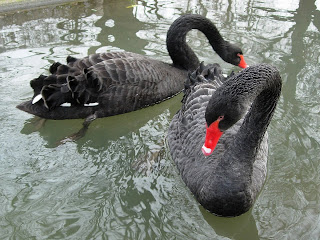
Black Swans
This must be pure coincidence ... but more of that later.

In his book, The Black Swan, Nassim Nicholas Taleb discusses the reasons for our being blind to Black Swans (defined as events that we unable to predict due to our tendency to extrapolate historical data or past events.) I am still reading the book and have reached a very interesting point (from this posts point of views, that is; actually the whole book is extremely interesting) where the author discusses human tendency to simplify data and facts. Humans, rather quickly, simplify a set of facts as per their convenience / upbringing and come to a conclusion. We weave for ourselves a story and assign a cause to an event post-facto. For obvious (or not so obvious) reasons, we cannot assimilate all the data that is available. But worse we do not know that we do not assimilate all the data and pick ad choose as per convenience. This tendency is obviously not limited just to the humans. Even machines would do so (or do so more than humans as machines are built to supply closed form answers.

That got me thinking. What if there were people who take in all information that is made available. Or at least take more information than normal humans do. Then BAM. I realized that I know what would happen. Pure coincidence. I did not realize this when I listed The Curious Incident of the Dog in the Night-Time as a gift in my previous post. The protagonist, a child with 'special needs' takes in all information he gets (has a photographic memory) and does not take a judgment call (takes every information at face value) and is brilliant at Mathematics (perhaps, that's why). He is obviously a social misfit (his character is more complicated that can be described in two lines).

So, is it impossible for a normal human being to predict Black Swan?

Hmmm...

I haven't finished reading. Will update after I complete reading The Black Swan.

And then need to re-read The Curious Incident of The Dog in The Night-Time after I finish reading The Black Swan. I am glad I buy books.

Note: The picture used here belongs to Claudia Meyer. To see more such pictures, please visit her gallery.

Stumble Upon Toolbar

Tuesday, December 16, 2008

Removing Bias

distorted lotus
I am thrilled to bits!
I wish you could see the grin on my face as I type this.
Some time ago, I had proposed a new mechanism of studying companies.
I repeat my conclusions here:

If I were to conduct a scientific study on business strategies, I would report the context and the decisions live, recording the thought process (as revealed by behaviour) as it happens, without drawing any conclusion. Very much like the National Geographic or such similar recordings of wild life.

I might have just hit upon a new field of management study :-))))
Remember, you read it here first!


Now why am I thrilled?

I just started reading The Black Swan by Nassim Nicholas Taleb (those who have been following my blog already know that I have become a big fan of his after reading Fooled By Randomness. I have quoted from Fooled By Randomness here, here and here.)

Anyways, a few pages into the Black Swan and what do I see?
This:

"While we have a highly unstable memory, a diary provides indelible facts recorded more or less immediately; it thus allows the fixation of our unrevised perception and enables us to study later events in their own context."

Taleb is trying to introduce a method of removing what he calls,
"the retrospective distortion, or how we can assess matters only after the fact, as if they were in a rear view mirror (history seems clearer and more organised in history books than in empirical reality."


I am pleased as a punch to know that I am thinking on same lines as Taleb.

Note: The picture used here belongs to Neil Gould. To see more of his pictures visit his gallery.

Stumble Upon Toolbar

Monday, September 22, 2008

Why do I buy books

Old Books
I always read books twice. If possible within 6 months. I have experienced that re-reading a book within that duration ensures long term memory retention. That is why I need to buy books. So every book that I discuss on this blog has been purchased by me. Some on Amazon but most during trips. Nothing beats reading something interesting while waiting at airports.

Right now I am re-reading Fooled By Randomness by Nassim Nicholas Taleb. It has been dubbed "One of the smartest books of all time' by Fortune. I would agree, although I cannot claim any mastery over economics and finance.

The following extracts from the preface of the 2nd edition will tell you what to expect:

"Past events will always look less random that they were (it is called hindsight bias)."

"... we don't have much of a clue in the social "sciences" like economics in spite of the fanfares of experts."

"... the kind of luck in finance is of the kind nobody understands but most operators think they understand ..."

This is just the book I need to read (re-read?) to put the Wall St. happenings in perspective.

Note: The photograph used belongs to Zsuzsanna Kilián. Please go here to see more such photographs.

Stumble Upon Toolbar

My Library